Who can do what?
Set who can see, change or approve a record.
 BLG TECHNOLOGIES / CUSTOMER STORY
BLG used Prinevo’s agents to plan, build, review and test the project. A shared context layer kept the agents aligned. A learning layer helped retain useful feedback for future work. Two people guided the work and made the key decisions.
Completed in six weeks, including setup, review and QA.
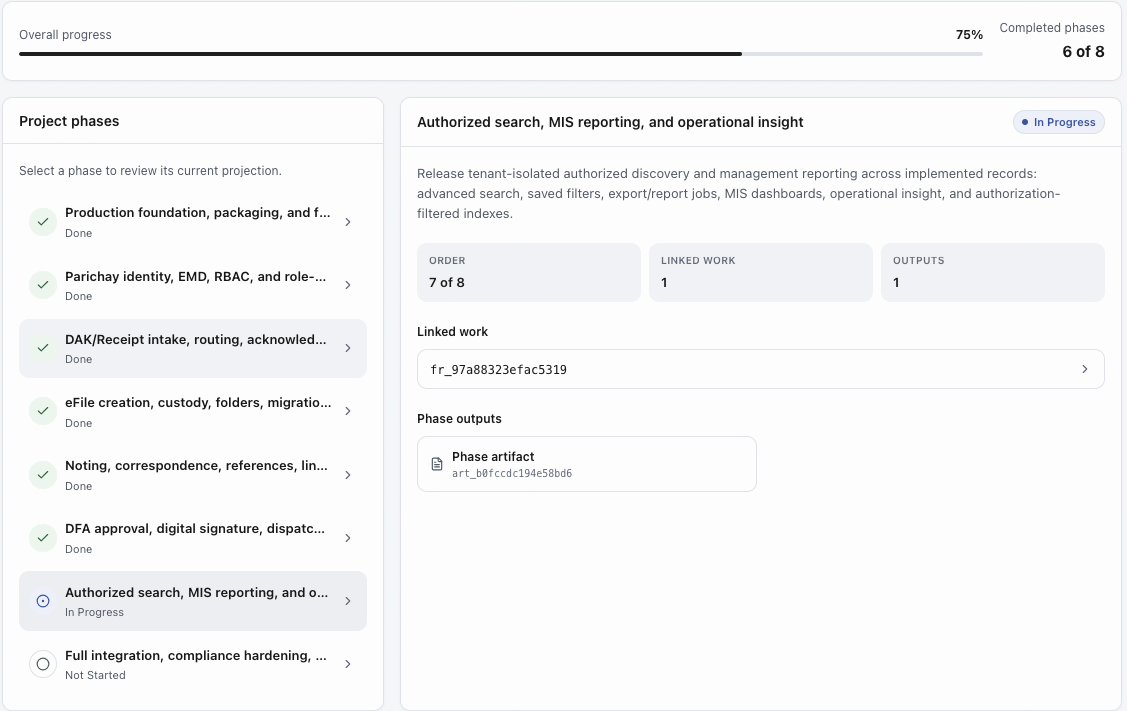
The main work areas in BLG’s project plan.
01 / THE PROJECT
The project covered user access, document handling, approvals, digital signatures and reports. The team needed a way to plan the work and check that these parts worked together.
Set who can see, change or approve a record.
Track incoming documents, files and messages.
Connect approvals and digital signatures to the files.
Show each user only the records they are allowed to see.
02 / HOW THE TEAM WORKED
Prinevo brought the work into one place. The team could review the plan, talk to the agents, give feedback and approve key steps as the project moved forward.
THE HUMAN TEAM
Two people worked on the project. Their individual hours were not recorded in this comparison.
THE AGENT TEAM
Each agent used the requirements, decisions and feedback from the earlier work.
Review findings + QA results + human feedback
Review what to keep. Update shared context, agent skills and checks for the next run.Code review and QA can send issues back to the coding agent. People can review the work before it moves to the next stage.
03 / CODE REVIEW AND QA
The code review agent checked the changes and returned issues for correction. The QA agent used the same requirements to test the feature. The team could see the findings and results alongside the work.
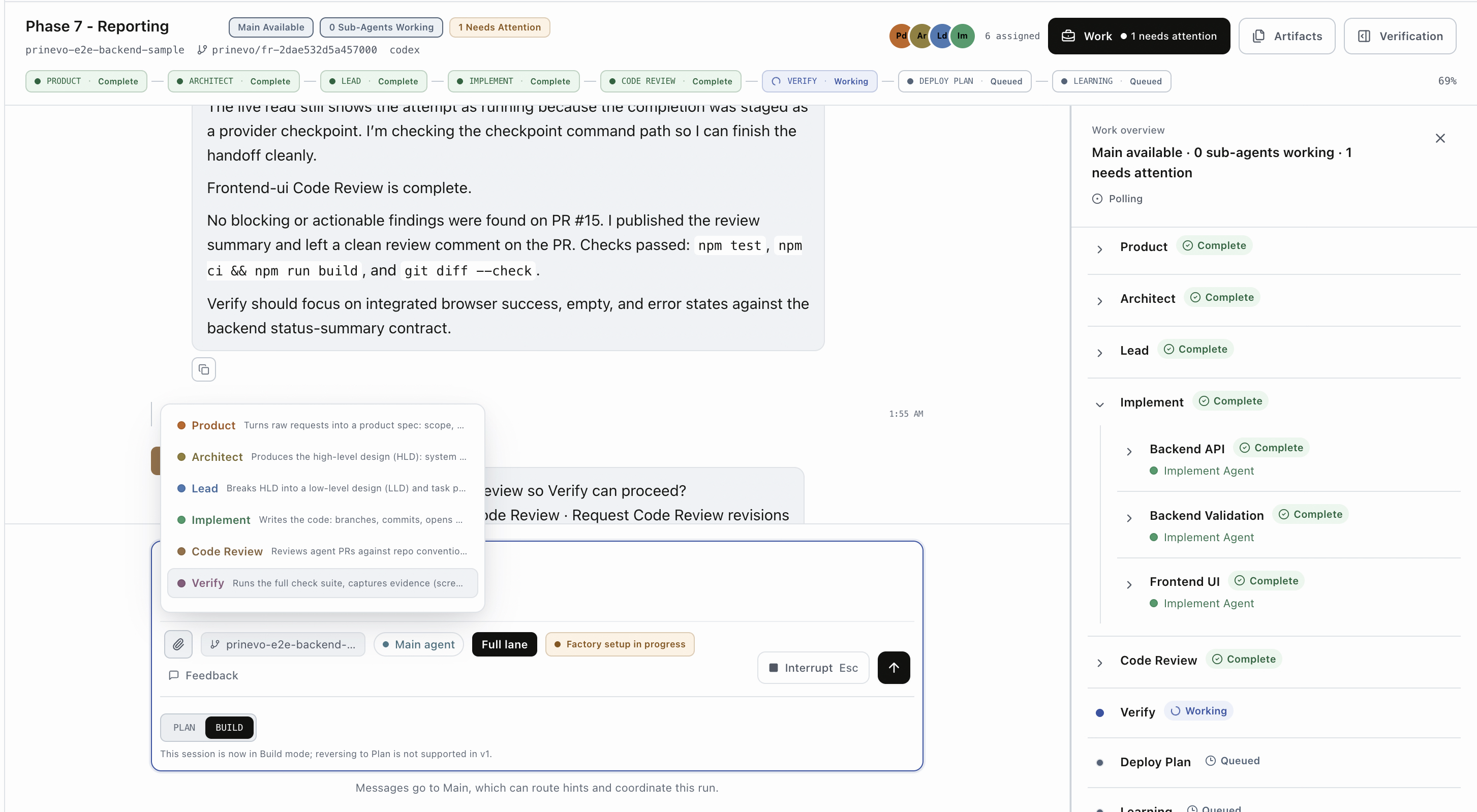
Agents handle the API, backend checks and frontend as separate tasks within the same run.
The reviewer asks QA to check success, empty and error screens after reporting its test and build checks.
The team can see that QA is running and release planning is waiting.
QA IN A SANDBOX
Prinevo’s QA agent starts the app and services in a sandbox, a separate environment for testing. It checks the feature against the requirements, including how the frontend, APIs and other services work together.
Check the APIs, screens and services that the change affects.
QA shows what failed. The coding agent fixes it. QA tests it again.
Keep the test results, logs and screenshots with the work. Show what could not be tested.
04 / SHARED CONTEXT AND LEARNING
Prinevo keeps project knowledge and learning in two connected layers. One gives agents the information they need now. The other turns useful feedback into improvements the team can review and reuse.
CONTEXT LAYER
Keep the business rules, requirements, design decisions and code knowledge together. The coding agent, reviewer and QA can all use them.
Less time explaining the same project again.LEARNING LAYER
Review feedback from people, code review and QA. Save useful decisions in context. Update agent skills or tests when the way of working needs to change.
Useful feedback carries into future work.WHAT SHARED CONTEXT MEANS
The coding agent needs to know which records each user can see. The reviewer needs that rule to check the code. QA needs it to test with different users. They all use the same business rule.
An example based on the reporting work in BLG’s plan.
HOW THE TWO LAYERS CONNECT
For the reporting example, save the agreed access rule in the context layer. If a correction shows that QA needs to check another user role, review an update to the QA skill or tests through the learning layer.
The next run can use both the business rule and the improved check. Learning changes the shared setup after review.
How feedback becomes learning ↗05 / THE RESULT
BLG completed the project in six weeks with two team members. That included setup, review and QA.
The original estimate was 12–14 weeks with four people. The figures below compare the actual delivery with that estimate.
Compared with the original 12–14 week estimate.
Two team members, compared with four in the estimate.
Setup, development, review and QA were included.
| Measure | Estimated baseline | With Prinevo |
|---|---|---|
| Elapsed delivery time | 12–14 weeks | 6 weeks |
| Team size | 4 members | 2 members |
Time saved against the estimate is (12 − 6) ÷ 12 = 50%, or (14 − 6) ÷ 14 ≈ 57.14%. That gives a range of about 50–57% less delivery time.
The team size fell from four people in the estimate to two in the actual project, a 50% reduction. This does not tell us the hours worked or cost saved. The comparison uses figures supplied by the project owner, not a separate trial or independent audit.
These figures compare an estimate with one completed project. They do not measure production reliability or how much later runs improved.
TRY IT ON YOUR OWN WORK
Bring one real change. See the agents plan, build, review and test it. Your team guides the work and reviews the results.